QIC Assess / CMP-IC Service
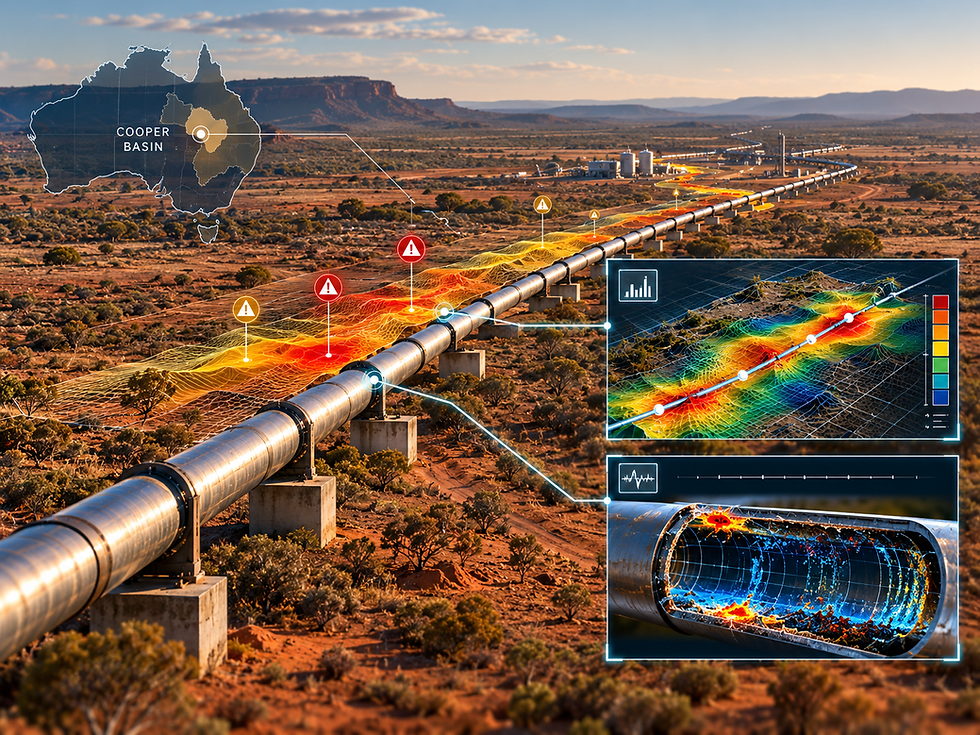
THE PIPELINE ENVIRONMENT

Localized exposure conditions matter
WATER-FILM RESIDENCE
WATER-FILM TRANSPORT
Changes along the route
TERRAIN + FLUIDS + OPERATIONS
One pipeline. Different localized enviornments.
Consider our forward-looking compliance and integrity management services.
Quantitative internal corrosion hazard profiling. Practical hazard-aligned mitigation controls based on changing Integrity Operating Windows (IOWs).
QIC Assess identifies the most probable locations where internal corrosion can develop and why.
CMP-IC turns that understanding into mitigation, operating limits and verification priorities for your pipelines.
THREE-PHASE MECHANISTIC MODELLING / CONDITION-BASED DECISIONS
Damage is an outcome.
Understand what creates it.

An inspection establishes pipeline condition at the time of the survey. Preventing future damage requires something more: an explanation of the corrosion environment, why damage develops where it does, and how that environment changes as operating conditions change.
QIC Assess integrates operating, integrity and corrosion information into a single mechanistic assessment. Pipeline geometry, elevation, fluids, operating history and integrity evidence are connected to spatial corrosion-hazard profiles that identify susceptible locations and the conditions capable of activating them.
The hydraulic foundation is a three-phase mechanistic steady-state flow correlation model. QIC Assess interprets local gas, oil and water behaviour along the pipeline to characterize liquid holdup, water-film transport, residence time, and the vulnerability to regional pH suppression to create an accurate corrosion damage profile.

01 / QIC Assess / Mechanistic Hazard Assessment
CHARACTERIZE
The distinction is local water behaviour
Water cut and bulk velocity alone do not establish where water accumulates, how long it remains, how it contacts the pipe wall, or whether corrosion treatment actually reaches the surfaces most susceptible to damage.

02 / Integrity Operating Windows
ANTICIPATE
A pipeline has more than one operating condition.
Ten project-specific flow cases test how credible operating changes affect corrosion exposure.
They support integrity operating windows (IOWs) by defining operating limits, review triggers and response requirements.
Explore an Operational Change
These examples illustrate typical operating-change review topics. The ten flow cases, operating limits and response criteria are defined specifically for each project.
This educational explorer demonstrates the review framework; it does not perform a corrosion-hazard assessment.
03 / CMP-IC / Corrosion Management Plan - Internal Corrosion
CONTROL + VERIFY
From hazard assessment to practical corrosion control.

The Corrosion Management Plan for Internal Corrosion (CMP-IC) translates the assessed corrosion environment into practical actions for operations, integrity and corrosion teams. It supports performance-based management by defining where controls are required, how their effectiveness is verified, and when changing conditions trigger reassessment.
Condition-based mitigation
IOWs and management of change
Monitoring and inspection priorities
Learning across the portfolio


Match inhibition, pigging and liquid-management measures to the identified mechanism and local exposure. Distinguish between preventing corrosion initiation and controlling established pits, deposits or persistent water-wet locations. Verify that the selected treatment can reach and protect the susceptible surface.
02
Define integrity operating windows, review triggers and required responses for routine service and credible operating excursions. Use them to manage declining production, shutdowns, restarts, oxygen ingress, fluid changes and facility upsets before a changed operating basis is accepted.
Direct monitoring and inspection toward susceptible locations, unresolved uncertainty and evidence of control performance. Use the results to confirm assumptions, verify mitigation effectiveness and refine future priorities.
Extend validated learning from inspected pipelines to technically comparable sibling assets. Confirm shared mechanisms, hydraulic behaviour, service history and mitigation before using that evidence to inform controls, inspection priorities and future assessment.

04 / Inspection + Portfolio Intelligence / Risk Management / Prevention
LEARN
Use inspection evidence
to strengthen prevention.

In-line inspection (ILI) establishes where internal corrosion damage has accumulated. By itself, however, it does not explain why the damage developed, whether the responsible conditions remain active, or whether existing controls will prevent recurrence.
QIC Assess connects inspection findings with the spatial corrosion-hazard profile, operating history and mitigation record. The comparison helps distinguish historical damage from current exposure, test the credibility of the assessed mechanisms, and determine whether corrosion controls are effective where they matter.
Both damage and its absence are evidence. Agreement between predicted hazard and observed damage strengthens the mechanistic interpretation. Differences may indicate effective mitigation, limited exposure, changing service conditions or an incomplete assessment basis—and therefore become opportunities for focused investigation rather than unexplained exceptions.
Across a portfolio, pipelines can also be organized into technically comparable sibling groups based on fluids, hydraulic behaviour, terrain, operating history, corrosion mechanisms and mitigation. Inspection evidence from one asset can then inform assessment and verification priorities for comparable pipelines, provided differences and uncertainty are explicitly considered.
Mechanistic hazard profiles also provide a foundation for future physics-informed predictive analytics. Combining hydraulic behaviour, operating history, mitigation performance and repeat inspection evidence could help identify corrosion-active operating states and improve forward-looking integrity decisions. Such extensions require dedicated development, testing and validation.
.png)
01 / PIPELINE LEVEL
02 / CONTROL LEVEL
03 / PORTFOLIO LEVEL
Explain the damage pattern
Verify mitigation effectiveness
Prioritize the next decision


Relate bottom-of-line, top-of-line and localized internal corrosion to credible mechanisms, hydraulic behaviour and historical operating conditions. Use the explanation to determine whether similar exposure remains credible under future service.
Combine ILI, monitoring, pigging, chemical-treatment and operating records to determine whether corrosion controls are effective at the susceptible locations and operating conditions identified by the assessment.
Use assessed hazard, inspection evidence, control performance and unresolved uncertainty to prioritize ILI, direct examination, monitoring and operational review. Direct resources toward the evidence most likely to improve the next integrity decision.
04 / PROJECT EXPERIENCE
Awareness first. Inspection evidence revealed afterwards.
For a 40-pipeline project covering approximately 1,000 km, QIC Assess corrosion-hazard profiles were completed before the associated internal-corrosion ILI findings were revealed for comparison.
The subsequent comparison examined pipelines exhibiting bottom-of-line damage, top-of-line damage and negligible internal corrosion. The results provided an independent test of the mechanistic hazard profiles and supported interpretation of the operating conditions associated with each damage outcome.
The project also demonstrated a broader opportunity: use inspection evidence not simply to identify damage in an individual pipeline, but to test the assessment basis, evaluate mitigation effectiveness and strengthen decisions across technically comparable assets.
Detailed findings, methodology and supporting exhibits are available for discussion in a technical workshop.


05 / Technical Insights
EXPLORE
The technical decisions behind
better corrosion decisions.
Explore the technical basis of QIC Assess / CMP-IC—from local water behaviour and mechanistic hydraulic modelling to operating scenarios, integrity operating windows and practical corrosion-management outputs.
See how the method strengthens established ICDA practice, what information is required for a defensible assessment, and how the results are translated into an actionable corrosion-management plan.


06 / The Technical Foundation
David Richardson, P.Eng.
TRUSTED PIPELINE ADVISOR - 1982 - 2026
Field Experience.
Mechanistic Understanding.
QIC Assess / CMP-IC is built on decades of work in pipeline integrity, internal corrosion and multiphase hydraulic modelling. The methodology connects the physical corrosion environment inside a pipeline with the operating decisions needed to prevent, control and verify internal corrosion.
David Richardson, P.Eng., has supported oil and gas operating teams since 1982. His work has focused on understanding how corrosion actually develops in service—combining field evidence, corrosion mechanisms, terrain, operating history and pipeline hydraulics to explain where exposure occurs, why it changes, and what can be done about it.
Trusted Pipeline Advisor developed the TPA corrosion model incorporated (in a simplified form) into AMPP / ICDA / Wet-Gas + Normally Dry-Gas Standards (2004) and also into SLB’s PIPESIM 2021.1 release as a premium subscription module.
QIC Assess / CMP-IC extends that mechanistic foundation into a practical integrity-management workflow, linking hydraulic behaviour, operating scenarios, inspection evidence and mitigation performance to support integrity operating windows, management of change and performance-based corrosion control.


07 / Predictive Analytics
FUTURE
From mechanistic understanding
to predictive intelligence.

Machine learning can identify patterns in large datasets. For internal corrosion, the more difficult problem is defining the physical context that gives those patterns meaning.
QIC Assess / CMP-IC provides a domain-informed framework for that next step. Mechanistic hydraulic modelling, spatial corrosion-hazard profiles, operating scenarios, mitigation history and inspection evidence can be organized into technically meaningful features describing the conditions under which corrosion becomes credible, active or controlled.
The opportunity is not to replace engineering judgement with an algorithm. It is to combine physics, operating history and integrity evidence so advanced analytics can recognize changing corrosion states earlier, prioritize uncertainty and support better forward-looking decisions.
Physics-informed features
Operating-state recognition
Inspection as learning evidence
Predictive decision support




Translate hydraulic behaviour, water transport, liquid holdup, residence, chemistry and operating conditions into structured descriptors that have physical meaning for internal corrosion.
Connect production decline, shutdowns, restarts, intermittent operation and facility upsets with changes in the corrosion environment rather than treating operating data as an undifferentiated time series.
Use ILI, direct examination, monitoring and mitigation performance as evidence to test relationships between predicted exposure, observed damage and effective control.
Develop models that help identify emerging corrosion-active conditions, prioritize inspection or intervention and indicate when an established operating basis should be reviewed.


08 / Start a conversation
YOUR NEXT STEP
Put the environment
at the center of the decision.


Whether the need is a single-pipeline assessment, a planned operating change or a portfolio-level review, the first step is to define the decision the work needs to support.
We can review the available operating, integrity and corrosion evidence, identify the relevant data and uncertainties, and define an assessment scope appropriate to the pipeline, service and management objective.
david@trustedpipelineadvisor.com
+1 403 880 2835